
2-Pounder Anti Tank Gun
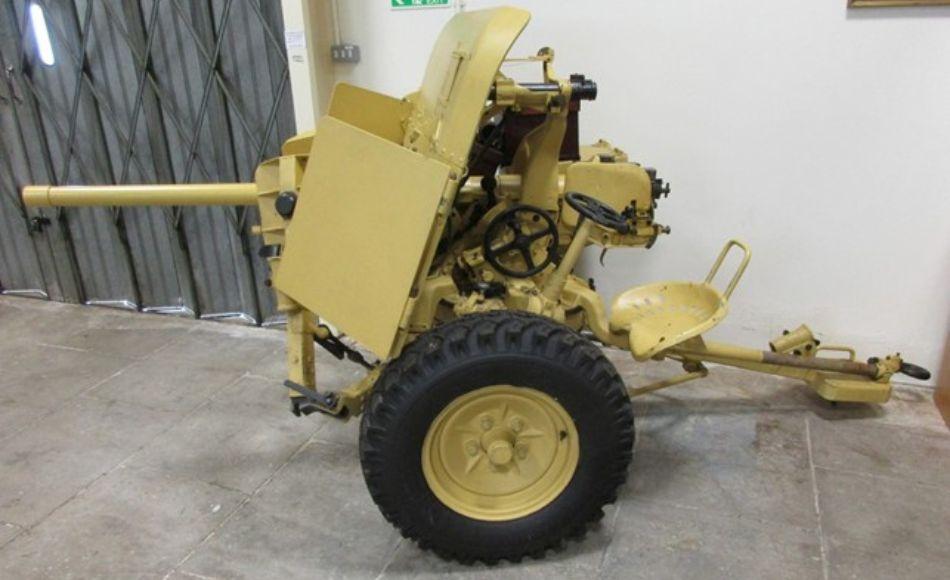
Introduced in 1936, the 2-pounder was considered to be the best anti-tank gun of its time, designed by Vickers to meet the dual need for an anti-tank gun and a tank weapon. While it could be brought into action on its road wheels, these could be quickly removed to place the gun on its three-legged platform, which provided good stability and 360-degree movement. With its semi-automatic breech mechanism a rate of fire of up to 22 rounds per minute could be achieved. Despite its relatively small 40mm bore, the armour-piercing rounds were highly effective at distances of around 1,000 metres.
The 2-pounder entered service with the Royal Artillery in 1938 and first saw action in WW2 with the British Expeditionary Force. Many were abandoned during the withdrawal to Dunkirk, being adopted into service by the German Army as the Pak 192. The 2-pounder subsequently saw extensive service in North Africa and the Middle East, where it was often mounted on the back of various flat-bed trucks for improved mobility.
2nd Lieutenant George Ward Gunn earned the Victoria Cross for his actions on 21 November 1941 at the Battle of Sidi Rezegh where he faced German Panzers at short range with a 2-pounder.
The 2-pounder soon became ineffective against increasingly heavy enemy armour, and during the course of WW2 it was superseded first by the 6-pounder and then the 17-pounder Anti-Tank Gun.