
Gardner Gun
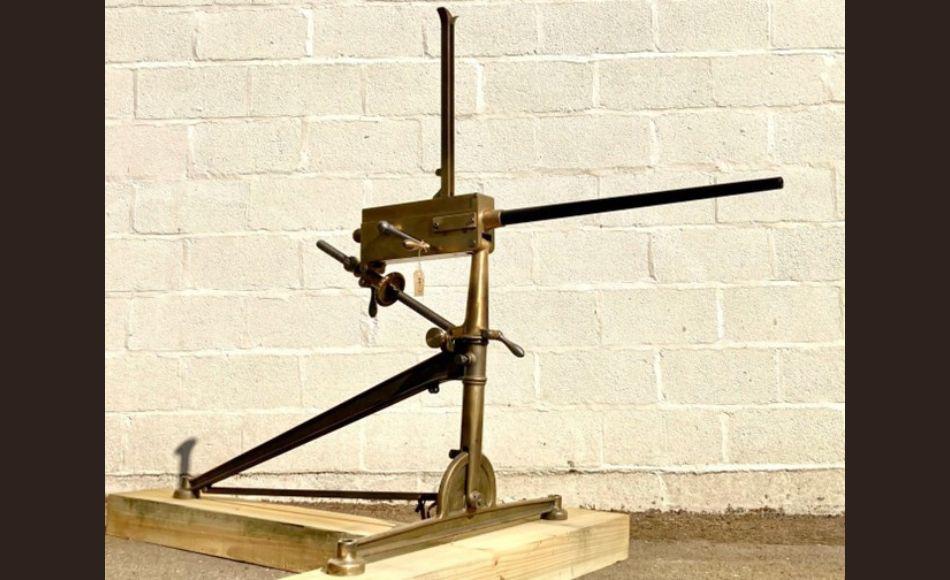
The Gardner Gun was created by William Gardner, a captain in the Union Army during the American Civil War (1861-1865), who was no doubt impressed by the Gatling Gun’s performance during the war and inspired to invent a lighter gun with similar performance. Operated by a crank handle, and with ammunition fed from a vertical magazine or hopper, the Gardner Gun achieved a firing rate of 10,000 rounds in 27 minutes during trials.
In 1875, the Pratt & Whitney Company were persuaded to develop and manufacture the gun, and three versions were developed (with one, two or five barrels). However, Gardner failed to secure any orders from the US Government (perhaps because they were satisfied with the Gatling Gun). He travelled to Britain, where the War Office was encouraged by the prospect of production in England, and several guns were made in Leeds under his supervision and tested in 1878.
In 1880, the Royal Navy adopted the single barrel version, which saw service in Sudan (alongside Gatling Guns). Following further trials in 1881 the two-barrel version was recommended for the Army, but it was not adopted until 1887 due to objections – details of which are not known - made by the Royal Artillery.
Gardner Guns were eventually used by the British Army in the Mahdist War (1881-1899), the First Matabele War (1893-1894), and during WW1. They were also employed as part of late 19th century garrison flank defences (replacing the old smooth bore artillery). A two-barrel gun was positioned on a parapet carriage at Fort Nelson manned by the Hampshire Artillery Volunteers