
6-pounder Field Gun: The Waterloo Gun
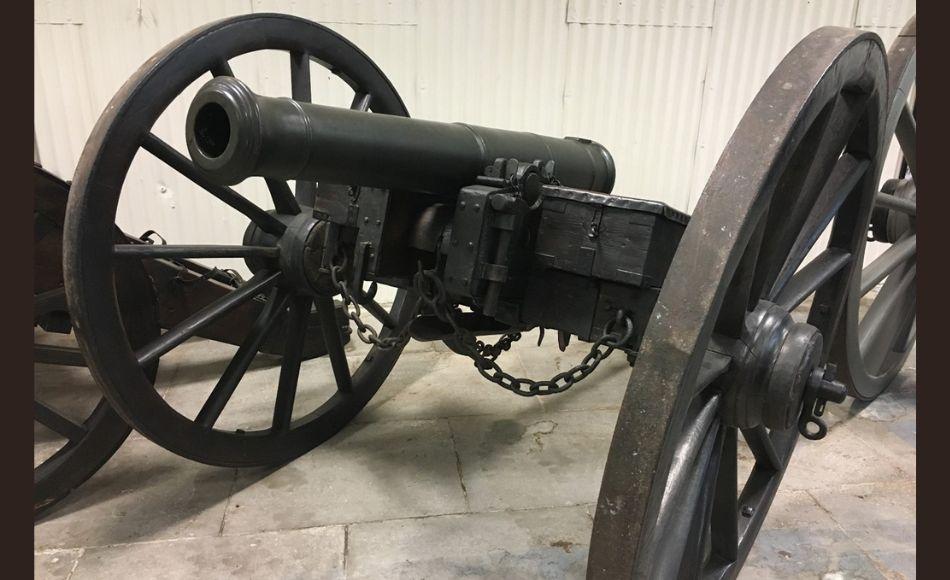
The smooth bore muzzle-loading 6-pounder was a standard light field piece from the mid-1700s to the mid-1800s, with only relatively minor changes to the design of the barrel during that time. It could achieve a maximum range of about 1,500m (although it was only really effective at around half that distance), and was used with round shot, canister shot and case shot.
A major step forward came in the 1770s with the introduction (by General Thomas Desaguliers) of the single block-trail carriage. Lighter and easier to use than previous designs, this style of carriage remained in use for around a century, until steel began to replace timber in carriage construction.
When the first troops of the Royal Horse Artillery were formed in 1793, the light 6-pounder on a block-trail carriage proved ideal, providing a piece that was manoeuvrable enough to allow the guns to keep pace with the cavalry they were intended to support. In this role it became a key weapon of the Napoleonic wars.
This example was cast in 1796 by Francis Kinman, to the pattern designed by Thomas Blomefield. It is referred to in our catalogue as “The Waterloo Gun”, and while we can find no definitive proof that it saw action at that battle it is certainly representative of the type of guns deployed by F Troop, E Troop and 2nd Rocket Troop RHA on 18 June 1815.